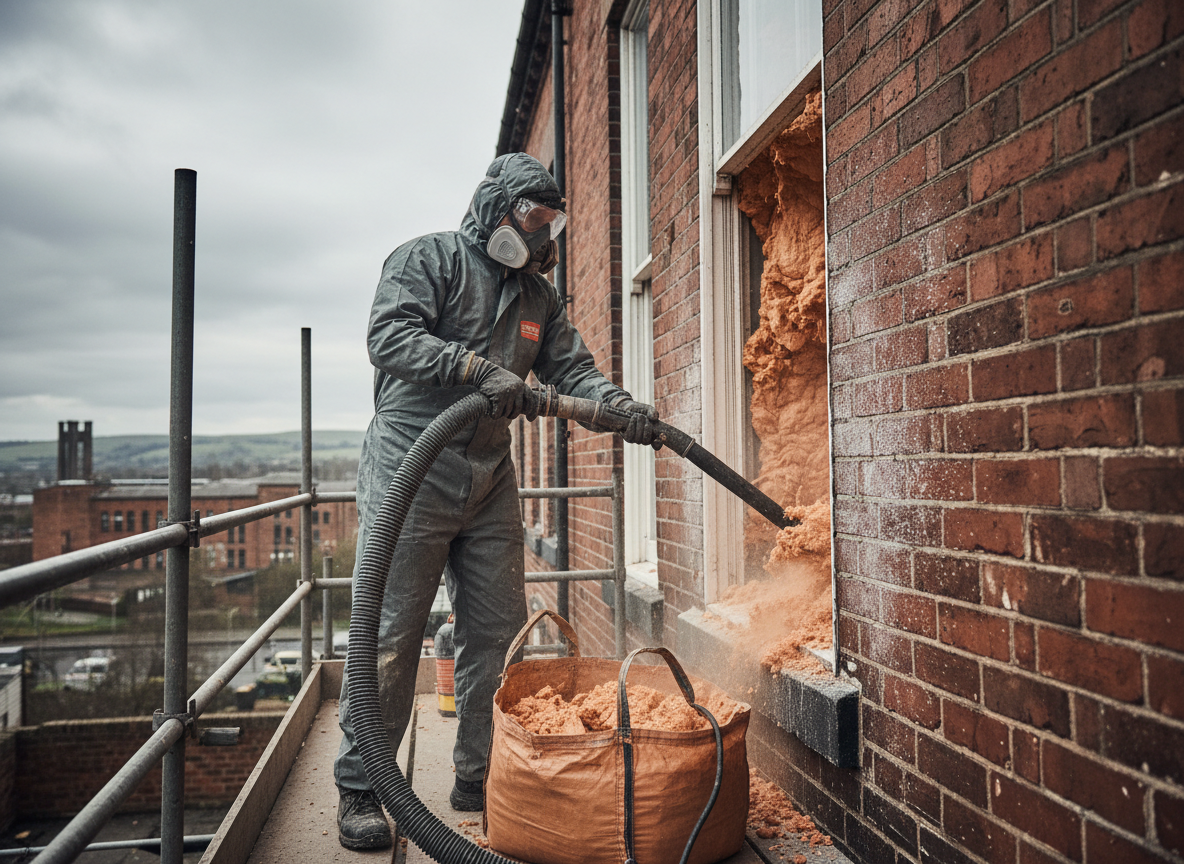
Sheffield's older housing stock, particularly Victorian and Edwardian terraces in areas like Walkley and Crookes, often received cavity wall spray foam insulation decades ago. Over time this material degrades, traps moisture against the inner leaf, and leads to penetrating damp that affects internal finishes. Removal requires careful drilling into mortar joints rather than brick faces, followed by mechanical extraction that accounts for the narrow cavities typical in these builds. The wet Sheffield climate accelerates foam breakdown, so jobs frequently reveal hidden timber decay that must be addressed before any re-insulation.
Access is complicated by the dense layout of Sheffield streets where properties share ginnels and rear yards. Technicians must work around retained garden walls and limited scaffold positions while containing dust and debris. Once the foam is cleared, cavities are left ventilated to dry naturally before any new insulation is considered. Homeowners in the S1 to S10 postcodes commonly discover the foam was applied over existing rubble-filled sections, requiring additional probing to avoid leaving pockets that continue to hold water.
Edge cases include properties near the River Don where higher water tables increase the risk of residual moisture after removal. In these situations, temporary weep holes are left open longer and monitored before any wall finishes are reinstated. All extracted material is bagged on site for licensed disposal, and every cavity is photographed at each stage so the homeowner can see exactly what was removed and what remains.
Technician insight
In Sheffield, the thing that catches most people out with Cavity wall spray foam removal is how many pre-1919 terraces still have narrow cavities partly filled with rubble; the foam bonds to the debris and you end up chasing pockets right down to the damp-proof course, especially after a wet winter.
Nether Edge Terrace Damp Investigation
A homeowner in Nether Edge reported persistent internal damp on a gable wall. Inspection showed spray foam had been injected over a partial rubble fill. We opened mortar joints at three levels, extracted the foam and debris, ventilated the cavity for two weeks, and confirmed moisture levels had dropped before closing the access points.
How it works
- 1
Site Inspection
We examine cavity widths, mortar condition and any signs of damp in Sheffield terraced homes, using borescopes to map foam distribution.
- 2
Access Preparation
Strategic entry points are created through mortar joints, with protection for internal floors and external paving common in city-centre yards.
- 3
Foam Extraction
Specialist tools break down and remove the foam while preserving the original wall ties and avoiding damage to narrow Sheffield cavity walls.
- 4
Cavity Drying and Verification
Remaining debris is cleared, cavities are ventilated, and moisture readings are taken before any reinstatement work begins.
Pricing
Pricing depends on property age, cavity access and extent of foam; we provide a clear quote after inspection from our Sheffield City Centre base.